Perspectives by HAP
Issue · 15 July 2026 · HAP Consulting UK
Performance & Leadership
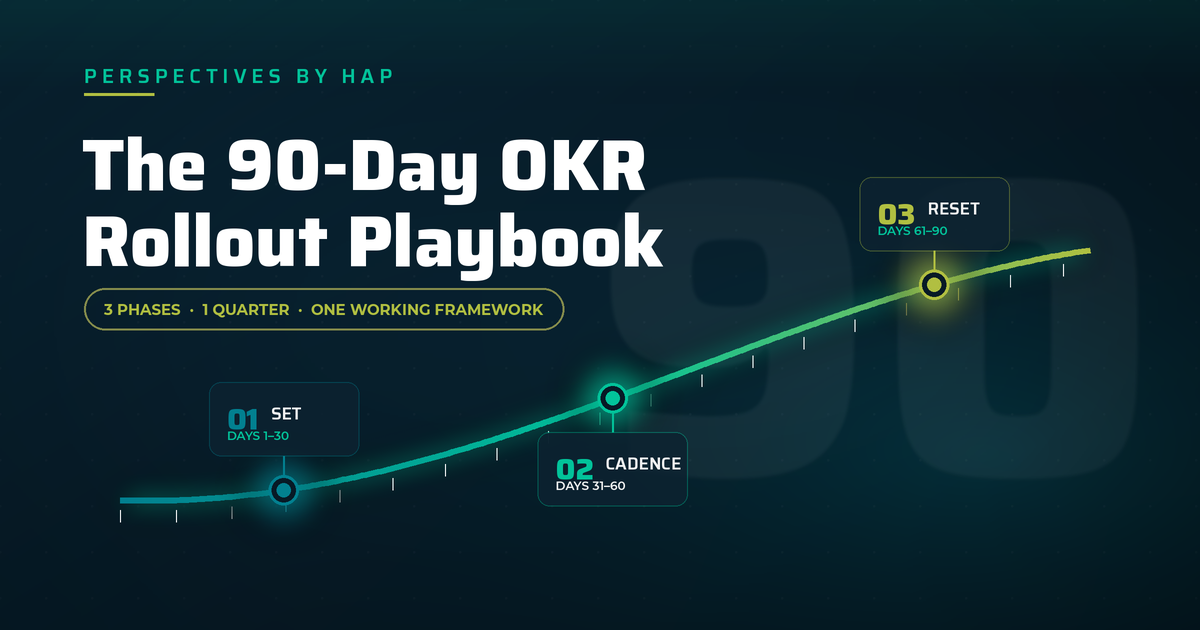
The 90-Day OKR Rollout Playbook
You do not need a year to make OKRs real. You need one quarter, run deliberately. Here is how to move from “we should probably do OKRs” to a working, embedded framework in ninety days.
Most OKR attempts do not fail because the goals were wrong. They fail because the rollout had no shape. Teams write ambitious objectives in a launch workshop, then go quiet for three months, and by the time anyone checks in, the framework has already been abandoned in favour of the old to-do list.
The fix is not more ambition. It is a deliberate cadence over a single quarter. In our May case study on OKRs in the care sector, we showed what the framework can do. This is the follow-up you asked for: the practical, step-by-step version you can actually run.
The structure here draws on the deployment approach set out by Ben Lamorte in The OKRs Field Book and in Objectives and Key Results (Niven and Lamorte): start small, coach the cadence, and treat the first cycle as a learning cycle rather than a performance verdict. We have mapped it onto ninety days using the rollout template we ran with a UK supported living provider.
Why ninety days
Lamorte’s guidance is to move crawl, then walk, then run: begin with a pilot, get OKRs right on a small scale, and only then extend them across the organisation. A single quarter is the shortest honest unit of that journey. It is long enough to complete one full cycle of setting, checking in and reflecting, and short enough that momentum does not leak away. The three phases below each take roughly thirty days.
- Answer “why now” first. Before a single objective is written, name the reason you are adopting OKRs this quarter. Lamorte is firm on this: clarity of purpose is what makes the rest stick.
- Choose one pilot team. Do not roll out to everyone at once. Pick a single team where the outcome matters and leadership is engaged. The whole organisation is watching, but only one team is running.
- Write one objective and no more than three key results. Restraint is the discipline. A short, memorable objective beats a comprehensive one nobody recalls by week three.
- Make key results measurable outcomes, not tasks. “Launch the new induction pack” is a task. “Lift new-starter competency sign-off from 60 to 90 percent” is a key result. If it cannot move on a scale, it is not a key result yet.
- Do not force OKRs onto every individual. Set them at the team level. Requiring every person to write personal OKRs in the first cycle is the fastest route to resentment and box-ticking.
- Name a Key Result Champion for each result. One person owns the number and reports on it. Ownership without a name is ownership by nobody.
- Hold a short weekly check-in. Fifteen to twenty minutes. The check-in is the engine of the whole system. Skip it and the objectives quietly die.
- Use the four-box check-in. For each key result, capture four things: current value, confidence level, blockers, and next steps. It keeps the conversation honest and forward-looking rather than a status parade.
- Score confidence, not just colour. Ask the champion how confident they are of landing the result, on a simple scale. A falling confidence score is an early warning you can still act on.
- Coach, do not audit. The check-in is a working conversation about what would move the number, not a test the team can pass or fail. Tone here decides whether people tell you the truth.
- Protect the pilot. This is the phase where new frameworks get crowded out by business as usual. Guard the check-in slot in the diary as if it were a client meeting.
- Score the cycle honestly. Grade each key result from 0 to 1. A committed result landing around 0.7 is a healthy outcome, not a failure. Straight ones every time means the targets were too soft.
- Reflect before you reset. The number is a prompt, not a verdict. Ask what it taught you about the work, the target, and the assumptions underneath it.
- Reset the next cycle from what you learned. Carry forward what worked, retire what did not, and rewrite the objectives with sharper key results.
- Decide whether to scale. Only now do you extend beyond the pilot. A rollout that has survived one honest cycle is ready to walk into a second team. One that has not is telling you something useful.
A rollout that survives one honest cycle earns the right to scale. One that does not is giving you information, not a defeat.
From the field
What one quarter actually changed
Working with a UK supported living provider, we ran exactly this ninety-day structure. The weekly cadence was what moved the numbers, not the launch workshop. And when one team member’s scores dipped later in the year, that was the framework doing its job: it surfaced the problem early rather than letting it hide until an inspection found it.
The one mistake to avoid
Do not treat the launch workshop as the rollout. The workshop is thirty minutes of enthusiasm. The rollout is the twelve check-ins that follow. Almost every failed OKR programme we are asked to rescue has the same shape: a strong start, no cadence, and a quiet death by week five. Get the weekly rhythm right and the rest of the framework has somewhere to live.
Take it with you
The one-page playbook
The full three-phase rollout on a single page. No form needed.
Is your organisation OKR-ready?
We run a free, no-obligation OKR readiness assessment: a single structured conversation that tells you honestly whether the framework fits where you are right now, and what a ninety-day rollout would look like for your team.
Book Your Free Assessment